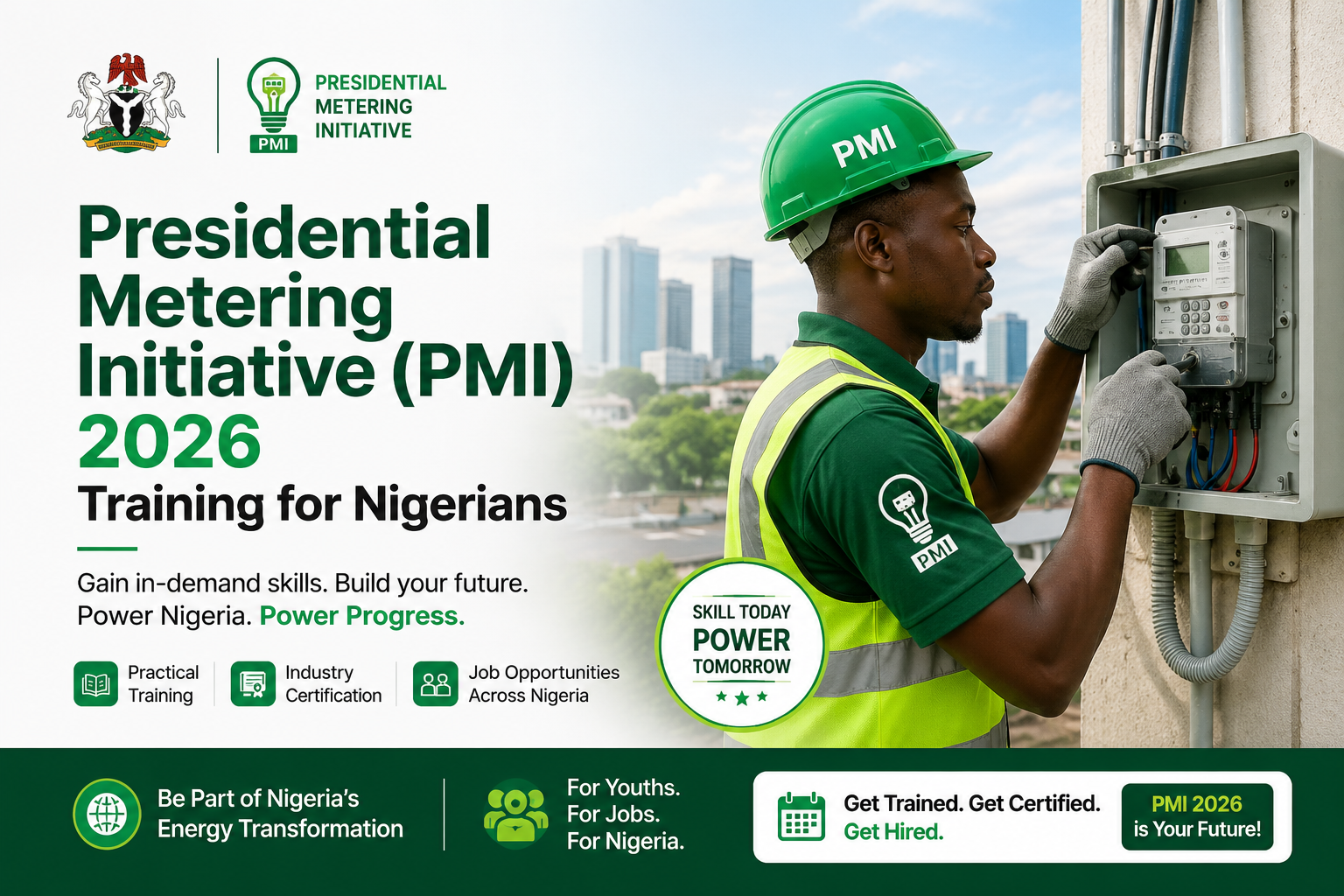
Are you a Young Nigerian? Learn how to apply for the Presidential Metering Initiative (PMI) Training for Nigerians 2026/2027 in Nigeria. Discover the eligibility requirements, benefits, training process, career opportunities, and official application portal for the Presidential Metering Initiative 2026.
Presidential Metering Initiative Training for Nigerians
Nigeria’s power sector is undergoing one of its biggest transformations in decades, and one of the flagship programmes driving this change is the Presidential Metering Initiative (PMI). Designed to accelerate electricity metering nationwide while creating employment opportunities for young Nigerians, the initiative has become one of the most talked-about government-backed skills development programmes.
For many job seekers, technicians, engineering graduates, artisans, and young professionals, the PMI Training Programme offers an opportunity to gain practical technical skills, earn an industry-recognized certification, and position themselves for employment within Nigeria’s growing electricity and renewable energy sectors.
If you are searching for “PMI Training 2026/2027,” “PMI NAPTIN registration,” “Presidential Metering Initiative application,” or “How to become a certified smart meter installer in Nigeria,” this guide explains everything you need to know before submitting your application.
What Is the Presidential Metering Initiative (PMI)?
The Presidential Metering Initiative (PMI) is a Federal Government programme established to support the nationwide rollout of smart electricity meters, reduce estimated billing, improve transparency in electricity consumption, and strengthen Nigeria’s power distribution system.
A major component of the initiative focuses on training thousands of Nigerians as certified smart meter installers and technical personnel through the National Power Training Institute of Nigeria (NAPTIN).
The programme is intended to build a skilled workforce capable of supporting electricity distribution companies, meter asset providers, renewable energy businesses, and other organizations operating within Nigeria’s energy sector.
Unlike many short-term empowerment programmes, the PMI training emphasizes practical technical competence that can translate into long-term employment and entrepreneurship opportunities.
Why the Presidential Metering Initiative Matters
Nigeria has faced electricity metering challenges for many years. Millions of electricity customers have historically relied on estimated billing because they lacked functional meters.
The Federal Government introduced the Presidential Metering Initiative 2026 to help address this challenge by:
- Expanding the availability of electricity meters.
- Training a qualified technical workforce.
- Improving customer confidence in electricity billing.
- Supporting local technical capacity.
- Creating employment opportunities for Nigerians.
- Encouraging growth within the power sector.
As more homes and businesses receive smart meters, the demand for trained installers and maintenance technicians is expected to remain strong.
Who Is Managing the Programme?
The technical training component is coordinated by the National Power Training Institute of Nigeria (NAPTIN), Nigeria’s leading power-sector training institution.
NAPTIN works with government stakeholders to develop industry-standard training programmes covering:
- Smart meter installation
- Electrical safety
- Meter testing
- Customer service
- Power distribution fundamentals
- Field operations
- Installation best practices
Applicants register through the official PMI training portal managed in collaboration with NAPTIN.
Why Many Nigerians Are Interested in PMI Training
The programme has generated significant interest because it combines several attractive benefits:
1. Practical Technical Skills
Rather than focusing only on classroom theory, participants receive practical exposure to modern electricity metering systems.
2. Government-Backed Training
Training is delivered under a government-supported initiative, increasing confidence in the programme’s credibility.
3. Employability
Certified participants may become more competitive for opportunities with:
- Electricity Distribution Companies (DisCos)
- Meter Asset Providers (MAPs)
- Renewable energy firms
- Electrical engineering companies
- Technical service contractors
Employment depends on market demand, employer requirements, and individual performance; participation does not guarantee a job.
4. Entrepreneurship Opportunities
Some graduates may choose to establish businesses providing electrical installation and metering services, subject to applicable licensing and regulatory requirements.
5. Contribution to National Development
Participants contribute to improving electricity access and billing accuracy across Nigeria.
Who Can Apply?
Although each application cycle may have specific requirements, applicants are generally expected to:
- Be Nigerian citizens.
- Meet the published educational requirements for the programme.
- Demonstrate an interest in technical or electrical work.
- Complete the application accurately.
- Provide required supporting documents.
- Meet any additional criteria announced for the specific cohort.
Applicants should always review the latest eligibility requirements published on the official application portal before submitting an application.
Who Should Consider Applying?
The programme is for every Nigerian but may be particularly suitable for:
Engineering Graduates
Graduates in:
- Electrical Engineering
- Electronic Engineering
- Mechanical Engineering
- Mechatronics
- Energy-related disciplines
may find the training relevant to their career development.
Polytechnic Graduates
Holders of:
- National Diploma (ND)
- Higher National Diploma (HND)
in related technical disciplines may also benefit.
Technical College Graduates
Individuals with vocational or technical education may gain additional industry-recognized skills.
Electricians and Technicians
Experienced artisans seeking to update their skills in smart metering technology may find the programme valuable.
Young Job Seekers
Young Nigerians interested in developing practical, employable skills within the power sector can also consider applying if they meet the published requirements.
Skills Participants May Learn
The curriculum may include topics such as:
- Fundamentals of electricity metering
- Smart meter technology
- Meter installation procedures
- Electrical safety standards
- Customer engagement
- Fault diagnosis
- Meter inspection
- Quality assurance
- Field reporting
- Basic maintenance procedures
The exact curriculum may vary between training cohorts.
Why Smart Meter Skills Are Becoming More Valuable
Nigeria’s electricity sector continues to modernize through investments in:
- Smart infrastructure
- Digital monitoring systems
- Renewable energy integration
- Grid modernization
- Improved customer billing systems
As these initiatives expand, demand for trained technical personnel is expected to grow across both public and private sectors.
Professionals with relevant technical skills may find opportunities in installation, maintenance, customer support, inspections, and technical supervision.
Benefits Beyond Employment
Even for participants who do not immediately secure employment, the training can provide:
- Improved technical knowledge.
- Enhanced professional confidence.
- Practical field experience.
- Better understanding of electricity systems.
- Networking opportunities within the power sector.
- Skills that may support future entrepreneurial ventures.
These competencies can complement other technical qualifications and broaden career options.
PMI Training Requirements, How to Apply, Training Process & Official Portal
Official Eligibility Requirements for the Presidential Metering Initiative (PMI)
One of the first questions prospective applicants ask is:
“Who is eligible for the Presidential Metering Initiative (PMI)?”
While each application cycle may include updated criteria, applicants should always consult the official PMI and NAPTIN announcements for the latest requirements. Generally, successful applicants are expected to satisfy the published eligibility conditions before proceeding with registration.
Typical requirements include:
- Nigerian citizenship.
- A valid means of identification.
- The minimum educational qualification specified for the current cohort.
- Interest in technical, engineering, electrical, or energy-related work.
- Ability to participate in practical training sessions.
- Submission of complete and accurate application information.
NOTE: Meeting the basic eligibility requirements does not automatically guarantee selection, as applications may exceed available training spaces.
Educational Qualifications
Depending on the intake and specialization, eligible applicants may include individuals with qualifications such as:
- SSCE (where accepted for specific technical tracks)
- National Diploma (ND)
- Higher National Diploma (HND)
- Bachelor’s Degree (B.Sc. or B.Eng.)
- Technical or vocational certificates
- Other qualifications specified in the official advertisement
Applicants should rely only on the educational requirements published for the current application cycle.
Documents Required During Registration
Applicants should prepare clear digital copies of the documents requested during the application process.
Commonly requested documents may include:
1. National Identification
Examples include:
- National Identification Number (NIN)
- National Identity Card
- International Passport
- Permanent Voter’s Card
- Driver’s Licence
2. Educational Certificates
Upload the highest qualification required for your application.
3. Passport Photograph
Use a recent passport photograph with a plain background if requested.
4. Contact Information
Applicants should provide:
- Active email address
- Valid mobile phone number
These details may be used for application updates and communication.
5. Additional Supporting Documents
Depending on the programme requirements, applicants may be asked to submit additional documents or declarations.
Always follow the instructions provided on the official application portal.
Step-by-Step Guide to Applying for PMI Training
The application process is designed to be completed online.
Step 1: Visit the Official PMI Training Portal
Go to the official application portal managed in collaboration with NAPTIN:
PMI Training Portal: https://pmi.naptin.gov.ng
Before beginning your Presidential Metering Initiative 2026 Application, ensure you have a stable internet connection and all required documents available.
Step 2: Create an Applicant Profile
Provide your:
- Full name
- Email address
- Mobile number
- Password
Always use an email address you check regularly.
Step 3: Verify Your Account
Follow any verification instructions sent to your email address or phone number.
Step 4: Complete Your Personal Information
Fill in all requested details carefully, including:
- Personal information
- Educational history
- Contact address
- Local Government Area
- State of origin
Avoid spelling mistakes, as incorrect information may affect your application.
Step 5: Upload Supporting Documents
Ensure uploaded files are:
- Clear
- Complete
- Readable
- In the required format
- Within the maximum file size
Poor-quality uploads may delay processing.
Step 6: Review Your Application
Before submitting:
✔ Check spellings.
✔ Confirm certificate details.
✔ Verify your phone number.
✔ Confirm your email address.
✔ Ensure uploaded documents are correct.
Taking a few extra minutes to review your application can help prevent avoidable errors.
Step 7: Submit Your Application
After submission, you may receive an acknowledgement or reference number.
Keep this information for future correspondence.
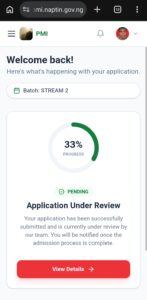
What Happens After You Apply?
After the application period closes, applications may go through several stages, which can include:
- Initial screening.
- Eligibility verification.
- Document review.
- Selection based on programme criteria.
- Communication with shortlisted applicants.
The exact process may vary depending on the training cohort and programme needs.
Training Centres
PMI training is delivered through facilities associated with the National Power Training Institute of Nigeria (NAPTIN).
Training may be conducted at designated centres across Nigeria, depending on programme logistics and available capacity.
Applicants should wait for official communication regarding assigned training locations rather than making travel arrangements in advance.
What Will Participants Learn?
The training combines classroom instruction with practical technical exercises.
Topics may include:
Smart Meter Installation
Participants learn installation procedures and industry best practices.
Electrical Safety
Safety remains a core component of all technical training.
Areas covered may include:
- Safe working practices.
- Personal protective equipment.
- Hazard identification.
- Emergency response procedures.
Meter Configuration
Participants may receive training on meter setup, testing, and commissioning.
Customer Service
Technical skills are complemented by customer interaction and communication training.
Participants may learn:
- Professional communication.
- Customer complaint handling.
- Service ethics.
- Field professionalism.
Practical Field Exercises
Hands-on experience helps participants apply theoretical knowledge in realistic working environments.
Duration of the Training
The duration of each training programme depends on:
- Training category.
- Curriculum.
- Practical sessions.
- Programme schedule.
Applicants should refer to the official training announcement for details relating to their specific cohort.
Will Participants Receive a Certificate?
Successful participants who complete the programme according to its requirements may receive certification or other evidence of successful completion, subject to the programme’s terms and conditions.
Certification requirements can vary by training cycle.
Tips to Increase Your Chances of Selection
Although selection criteria are determined by programme administrators, applicants can strengthen their applications by:
- Applying early within the application window.
- Providing complete and accurate information.
- Uploading clear documents.
- Using an active email address.
- Following all official instructions carefully.
- Avoiding duplicate applications.
Submitting multiple applications using different details is generally discouraged and may create complications.
NOTE: Application has commenced since July 4 2026 and will end before the end of July
Common Mistakes Applicants Should Avoid
Many otherwise qualified applicants experience delays because of avoidable errors.
Some common mistakes include:
- Incorrect phone numbers.
- Wrong email addresses.
- Blurry document uploads.
- Incomplete application forms.
- Typographical errors.
- Missing required documents.
- Waiting until the final day to apply.
Preparing your documents before registration opens can make the application process much smoother.
READ ALSO:
How I Fixed Platform Restriction in Nigeria Using VPN in 2026
Natasha Akpoti-Uduaghan Biography 2026 Updated: (Age, Husband, Career, and Political Journey)
Cubana Chief Priest in 2026: Lifestyle & Social Life and Why he is Trending
Stay Updated Through Official Sources
Applicants should rely on official announcements for application dates, eligibility updates, and programme information. Bookmark this page for updates regarding the Application processes.
Official resources include:
- PMI Training Portal: https://pmi.naptin.gov.ng
- National Power Training Institute of Nigeria (NAPTIN): https://www.naptin.gov.ng
- Presidential Metering Initiative: https://pmi.com.ng
Avoid unofficial websites or social media posts that promise guaranteed admission or request payment in exchange for placement.
The Presidential Metering Initiative 2026 is an opportunity program for every Nigerian who desires to learn a new skill, make use of the guidelines provided on the Presidential Metering Initiative (PMI) Training for Nigerians 2026/2027: How to Apply, Eligibility, Benefits & Official Portal.
We wish you success as you apply, Cheer’s, do well to share this information with your friends and family who might need them, also drop your comments and our Team of Blogger’s will attend to them immediately.